

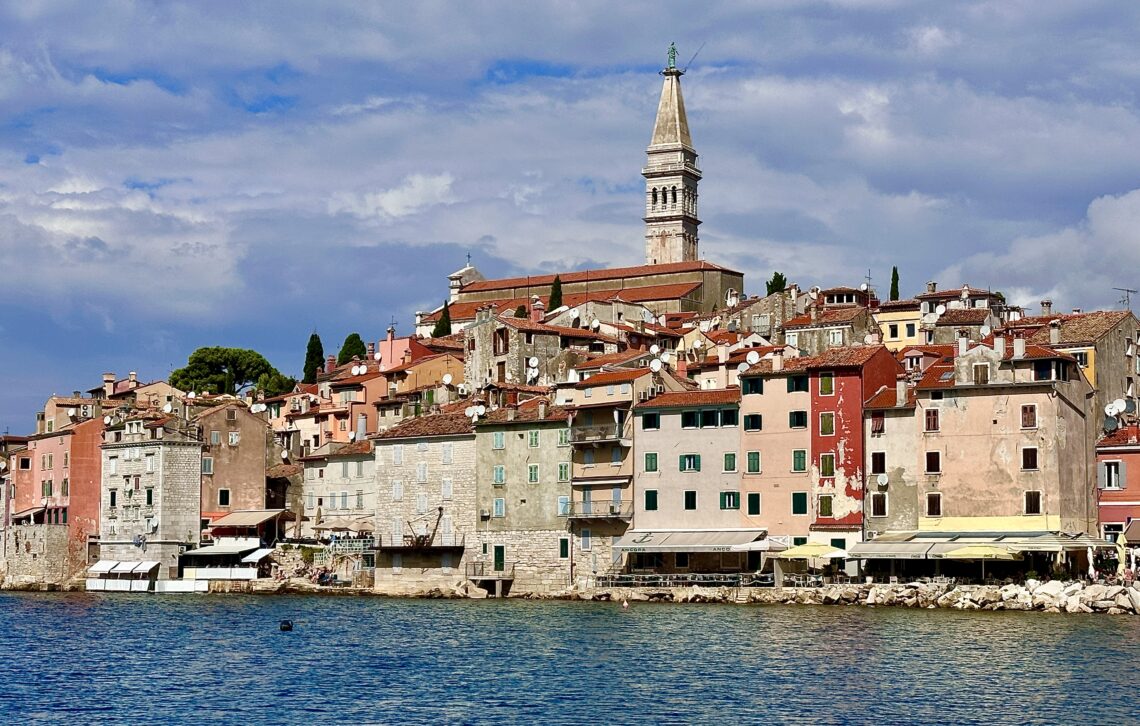
“Caught between the charm of Italy and the soul of Croatia in Rovinj.”
Wanderers Compass
- A Town That Was Once an Island
- Walking Through History
- At the Top, St. Euphemia
- The Market and Shopping in Rovinj
- Seafood, Pasta and a Lot of Italian Influence
- Ryan and His Son Head for the Islands
- Beyond the Old Town
- Pula Is Worth the Drive
- Blue Istria and Green Istria
- What We Learned About Staying in Rovinj
- Where to Stay in Rovinj
- A Lost Bag and a Little Croatian Hospitality
- Why Rovinj Deserves More Than a Day
- Listen to Our Istria Podcast
- Rovinj Photo Gallery
- Our Top Recommended Travel Products
There is one view of Rovinj that appears again and again in photographs of Croatia. Colorful buildings seem to rise directly from the Adriatic, crowded together beneath the towering Church of St. Euphemia. Fishing boats and yachts dot the water below, and when the light is right, the entire town takes on a warm glow that seems almost too perfect to be real.
The photographs are beautiful.
They also tell only a small part of the story.
We had visited Rovinj several times on previous trips through Croatia, but this was the first time we had stayed there. That changed our perspective completely. Instead of arriving for a few hours, walking through the historic center, and moving on, we had time to settle in.
We wandered the old streets without an agenda. We shopped. We swam. We ate seafood and plenty of pasta. We found waterfront tables where dinner stretched into sunset. Ryan and his son took a boat out to the islands to swim while the rest of us enjoyed Rovinj at our own pace.
We also used the town as a base for exploring more of Istria, something Rovinj is remarkably well positioned for.
What we discovered was a destination with far more range than its romantic photographs suggest. Rovinj has history, beaches, boating, excellent food, surprisingly good shopping, nearby wineries, family activities, and easy access to some of our favorite places in Istria.
The postcard may get you here.
Staying lets you discover everything it leaves out.
A Town That Was Once an Island


Understanding Rovinj starts with understanding its shape.
The historic center was once an island, separated from mainland Istria by a narrow channel. With limited room inside its fortified walls, people built close together and upward. The channel was eventually filled in during 1763, joining the settlement to the mainland, but the medieval street pattern survives.
Once you know that, the Old Town makes much more sense.
Buildings crowd together along narrow stone streets that climb toward the highest point of the former island. Passages twist rather than following a predictable grid. Houses seem to lean toward each other, and openings between buildings occasionally reveal brilliant flashes of the Adriatic below.
Rovinj was also shaped profoundly by Venice. The town pledged loyalty to Venice in 1283 and remained under Venetian rule until the fall of the Republic in 1797. Those centuries left their mark on the architecture, language, food, art, and culture. The Italian influence remains so strong that the town is officially bilingual, known as both Rovinj and Rovigno.
After Venice came periods of Austrian and Austro-Hungarian rule, Italian rule following World War I, Yugoslavia, and eventually independent Croatia. The result is a place where layers of history coexist rather than neatly replacing one another.
You don’t need to understand all of that before arriving.
But once you do, you begin noticing it everywhere.
Walking Through History


Rovinj is a town made for walking, although we would add one important qualifier: bring good shoes.
The historic center is largely pedestrianized, and the polished stone streets can be uneven and slippery, particularly when wet. This is not the place for shoes chosen solely because they look good with your vacation wardrobe. Even Rovinj’s tourism board recommends footwear with good grip for its old limestone streets.
Start around the harbor and Marshal Tito Square, where the Town Clock is one of the reminders of old Rovinj. Nearby, Balbi’s Arch stands on the site of the former Old Fish Market Gate, once a principal entrance into the fortified town.
Pass through and start climbing.
Grisia is Rovinj’s most famous old street and has long been associated with artists. Galleries and shops occupy historic spaces as the stone street rises toward St. Euphemia.
But don’t become too concerned about following a prescribed route.
Some of our favorite walks began because a street looked interesting.
Turn left. Climb the steps. Look through an archway. Follow a narrow passage toward a glimpse of blue water.
Rovinj rewards curiosity.
It also rewards getting away from the waterfront. The harbor and main streets can become very crowded during peak season, but we were continually surprised by how quickly things quieted down when we wandered a few streets inland.
Laundry appeared overhead. Residents sat outside their homes. Small galleries and restaurants replaced the busier shops.
The beautiful Old Town stopped feeling like scenery and started feeling like a neighborhood.
At the Top, St. Euphemia


Eventually, almost every uphill walk seems to lead to the Church of St. Euphemia.
The great Baroque church dominates Rovinj’s skyline, while its Venetian-inspired bell tower rises more than 60 meters above the town. From the hilltop, views extend across the rooftops, harbor, Adriatic, and Rovinj archipelago.
The church also carries one of Rovinj’s most enduring stories.
St. Euphemia was an early Christian martyr, and according to local tradition, her stone sarcophagus mysteriously floated across the Adriatic and arrived on the shores of Rovinj in the early ninth century. Her remains are housed inside the church that bears her name.
Above it all, a copper statue of St. Euphemia crowns the bell tower and moves with the wind.
Visitors can climb the tower, but even without doing so, the church plateau offers extraordinary views.
We found ourselves lingering here rather than simply taking a photograph and heading back down.
That’s something Rovinj does remarkably well.
It makes you stop.
The Market and Shopping in Rovinj


We hadn’t necessarily expected shopping to become part of our Rovinj experience, but it did.
The market is a good place to begin, particularly if you want to see some of the ingredients and products associated with Istria. Depending on the season and vendor, you’ll encounter produce and regional specialties alongside olive oil, truffle products, honey, lavender, spirits, and other things that are considerably more interesting to take home than a generic souvenir.
Then there are the shops scattered through town.
Carrera Street is Rovinj’s best-known shopping street, with clothing, footwear, jewelry, food shops, and everyday stores mixed among businesses catering to visitors. Grisia and the surrounding Old Town offer a different experience, with art, galleries, jewelry, crafts, and smaller boutiques. Rovinj also has more contemporary luxury and Croatian design shopping around Lungomare Plaza.
We enjoyed the variety.
You can shop for something beautifully designed, find artwork for your home, pick up a bottle of Istrian olive oil or wine, and then wander into a shop selling truffle products.
The trick is allowing enough time to browse.
We rarely managed to walk directly from point A to point B in Rovinj without something distracting us along the way.
Seafood, Pasta and a Lot of Italian Influence


If you enjoy seafood, Rovinj makes it very easy to eat.
Fresh fish, shellfish, squid, octopus, and other seafood appear on menus throughout the area, from simple preparations to sophisticated restaurants. But anyone expecting Croatian cuisine to look entirely different from what they might find across the Adriatic may be surprised.
Italy is everywhere.
Pasta and pizza are abundant. Cheese appears frequently. Risottos, handmade pastas, olive oil, and seafood preparations reflect the centuries of cultural exchange between Istria and Italy.
That Italian influence isn’t something added for tourists. It is part of the region’s history.
Istrian specialties add another dimension. Fuži, the distinctive rolled pasta found throughout the peninsula, and pljukanci, a hand-rolled pasta with a pleasantly chewy texture, provide particularly good vehicles for sauces involving mushrooms, meat, seafood, or truffles.
And Istria takes truffles seriously.
The forests inland produce both black and highly prized white truffles. Olive oil is another regional obsession, and excellent producers are scattered throughout the peninsula.
Then there is the wine.
Malvazija Istarska is Istria’s signature white grape and an easy companion to the seafood served along the coast. Teran is one of the characteristic local reds. Numerous wineries lie within driving distance of Rovinj, making wine tasting another easy addition to a longer stay.
Our Dining Highlight

Rovinj’s wine culture does not end at the vineyards. Several local wineries have a presence in town, making it easy to experience Istrian wine without leaving the historic center. Along the waterfront, restaurants pair regional wines with local cuisine and some of the best views in Rovinj.
We experienced this at San Tommaso Gourmet and Wine, located directly on the harbor and connected to the San Tommaso winery. We settled in for a delicious dinner and a bottle of local wine just as the sun began to set over the Adriatic. Boats crossed the harbor, the evening light softened across Rovinj’s colorful façades, and tables along the waterfront slowly filled around us.
It was one of those meals where the setting became as memorable as the food and wine. With the sun setting across the harbor and nowhere we needed to be, there was little reason to rush dinner.
Ryan and His Son Head for the Islands


Traveling with different generations often means accepting that not everyone needs to do everything together.
Rovinj made that remarkably easy.
While some of us were perfectly happy exploring the town, Ryan and his son headed out by boat to the islands of Sveti Andrija and Sveti Ivan Octojac, they were able to get off, swim in the Adriatic, and experience Rovinj from the water rather than from its streets.
It was exactly the kind of activity that works well for a younger traveler without requiring the adults to sacrifice their own vacation.
The waters around Rovinj offer plenty of variations on that experience. Boat excursions explore the archipelago, stop for swimming, head toward the Lim Channel, or go in search of dolphins. Fishing, kayaking, sailing, diving, and other water activities further expand the possibilities. The protected coastline around Rovinj includes 22 islands, making the sea a significant part of the destination rather than simply a backdrop.
You don’t need a boat to get into the Adriatic, either.
Beaches, rocky coves, and swimming areas surround Rovinj. In some places, getting into the water can be as simple as finding the right stretch of rock and going for a swim.
For families and multigenerational groups, that variety matters.
Not everyone wants another church.
Sometimes someone wants to jump into the sea.
Beyond the Old Town


One mistake would be spending several days in Rovinj and never venturing beyond the historic center.
Golden Cape Forest Park, or Zlatni Rt, provides an entirely different experience close to town. Forest, walking and cycling paths, rocky coastline, coves, and swimming areas make it easy to trade historic streets for nature without devoting an entire day to getting there.
Cycling is particularly popular around Rovinj, and the relatively gentle terrain around portions of the coast makes it accessible to more than serious cyclists.
Families have even more choices.
We noticed many families during our stay, including Croatian families vacationing on their own coast. Once we started looking at what was available, that made sense.
There are beaches, boating, kayaking, cycling, swimming, water sports, playgrounds, and other outdoor activities. In nearby Funtana, Dinopark brings life-sized dinosaurs, rides, and entertainment into the mix.
There are also adventure and recreational activities throughout Istria, including options for travelers who would much rather spend an afternoon being active than touring another historic site.
That diversity makes Rovinj particularly comfortable for multigenerational travel.
The adults don’t have to surrender good restaurants, wine, history, or culture to keep younger travelers entertained.
Pula Is Worth the Drive


One of our favorite excursions from Rovinj was Pula, roughly 40 kilometers to the south. We went primarily because of its Roman history, but this was actually our third visit. We love this city.
The Pula Arena alone is worth the trip. Constructed during the Roman era, the enormous amphitheater is one of the best preserved of its kind and still dominates the city more than 2,000 years later.
What surprised us on our first visit was how much Roman history exists beyond it. The Temple of Augustus stands in the old Forum, while the Arch of the Sergii, Hercules’ Gate, and other ancient remains are incorporated into the modern city. You aren’t visiting an isolated archaeological park. You’re walking through a living city, with Roman history appearing around every corner.
Pula also has a fascinating later military story. Its importance grew enormously under the Austro-Hungarian Empire, when it developed into the empire’s principal naval port. That combination of Roman and more recent history makes Pula far more interesting than simply driving down, photographing the Arena, and leaving.
In fact, Pula deserves much more than a few paragraphs here. We have an entire article dedicated to the city and everything there is to experience, including its remarkable history and top things to do.
While Pula makes an easy day trip from Rovinj, it is also an excellent base for exploring southern Istria. On our first visit, we stayed in the Pula area, which gave us more time to experience the city as well as the beaches, coastline, and other destinations farther south. This time, we spent the day surrounded by Pula’s many layers of history and still made it back to Rovinj for the evening.
Blue Istria and Green Istria


Rovinj’s location also makes it an excellent introduction to the two very different personalities of Istria.
Along the coast is what is sometimes described as Blue Istria: fishing towns, beaches, harbors, islands, and the Adriatic.
Vrsar is nearby, while Poreč, farther north, offers another attractive waterfront and the UNESCO-listed Euphrasian Basilica. Continue along the coast, and you reach Novigrad, another historic fishing town with its own personality.
Then turn the car inland.
The landscape changes.
This is Green Istria, and it is one of the reasons we keep returning to the region.
Vineyards, olive groves, forests, and valleys replace the Adriatic, while medieval towns appear on hilltops.
Motovun is perhaps the most famous, perched dramatically above the Mirna Valley and surrounded by an area known for truffles. Grožnjan has become associated with artists, galleries, and music. Buzet is another center of Istrian truffle country, while Oprtalj rewards anyone who enjoys small historic towns and panoramic views.
And then there is Hum.
Frequently described as one of the smallest towns in the world, Hum is tiny enough that the description doesn’t feel like much of an exaggeration.
These places are not simply side trips we recommend because they’re close to Rovinj.
They are a large part of why we love Istria.
One day can be about boats, seafood, and swimming. The next can involve medieval walls, vineyards, truffles, and wine tasting.
Very few regions make it this easy to change the entire character of your day without spending hours in the car.
What We Learned About Staying in Rovinj


Rovinj is easy to love, but there are a few things we would like readers to know before arriving.
First, comfortable shoes matter. The historic center involves hills, steps, and old polished stone.
Second, understand the parking situation before you arrive. Much of the Old Town is pedestrianized, which is wonderful once you’re settled but can complicate arriving with luggage.
We stayed at The Melegran in the historic center. The hotel itself was comfortable rather than a highlight of the trip, but its location was excellent, and the parking arrangement was extremely valuable. Once we arrived, we could leave the car and walk everywhere in town.
We were equally glad to have the car when we wanted to explore Istria.
Summer crowds are another reality.
Rovinj is popular for good reason, and the waterfront can become very busy. Rather than allowing that to bother us, we learned to change direction. Walk a few streets uphill, head into Golden Cape, go swimming, take a boat out, or explore somewhere else during the busiest part of the day.
Then come back.
Rovinj has a very different personality in the evening.
Where to Stay in Rovinj

Where you stay in Rovinj can shape your experience, and there are plenty of options both within the historic center and along the surrounding coastline.
We stayed at The Melegran, a boutique hotel spread across historic buildings in the heart of Rovinj’s Old Town. For us, the location was fantastic. We were just steps from the waterfront, restaurants, shops, and the narrow cobblestone streets that make wandering Rovinj so enjoyable. The staff was also incredibly friendly and helpful throughout our stay.
One thing to consider when staying in the historic district is accessibility. Many accommodations occupy centuries-old buildings, and that character can come with steep staircases, limited or no handrails, and no elevators. If you have mobility concerns or are traveling with heavy luggage, we recommend contacting your hotel before booking to confirm the exact location of your room and what is required to reach it.
The Old Town has seemingly endless choices, from boutique hotels and guesthouses to private apartments and vacation rentals. Staying here puts you right in the middle of everything and makes it easy to explore Rovinj on foot.
Staying Outside of the Historic Area
There are advantages to staying outside the historic center as well. Joelle’s sister and brother-in-law stayed in a charming apartment with beautiful views across the water toward Rovinj’s historic peninsula. They could easily get into town but also had convenient access to the roads when they wanted to explore more of Istria.
Along the waterfront north of the historic center, you will also find several larger, more luxurious resorts, some with spectacular views of Rovinj’s unmistakable skyline. These properties can offer more amenities, space, pools, and resort-style comforts, but check the location carefully. Depending on the property, walking into the historic center may not be practical.
Wherever you choose to stay, compare locations and recent guest reviews across several booking platforms before making a reservation. In Rovinj especially, a property that looks close on a map can feel very different once cobblestones, hills, pedestrian-only streets, and luggage enter the equation.
A Lost Bag and a Little Croatian Hospitality

Sometimes the moments that stay with us have nothing to do with the places we planned to see.
While staying at The Melegran in Rovinj, we bought some clothes and somehow managed to leave the shopping bag behind in the hotel’s bar. The embarrassing part was that we didn’t realize it was missing until about a week later, long after we had left Croatia.
We contacted the hotel, expecting the bag to be long gone. Instead, the staff told us they still had it. They hadn’t known who it belonged to, but they had kept it safe.
Then came an incredible coincidence. Joelle’s sister and brother-in-law were traveling to Rovinj just a couple of weeks later. The hotel graciously agreed to hold the bag until they arrived.
When Joelle’s brother-in-law walked into The Melegran and began explaining why he was there, he barely had time to finish. The staff knew exactly what he had come for and handed him the bag.
It was a simple act of kindness, but one we won’t forget. We have experienced that kind of warmth and hospitality throughout our travels in Croatia, and it is one of the many reasons we continue to love returning to this country.
Of course, Joelle’s sister and brother-in-law couldn’t resist having a little fun with the rescue mission. After Joelle sent them a photo of the missing bag so they would know what to look for, they recreated the scene on the streets of Europe with our well-traveled shopping bag finally on its way home.
A huge thank you to The Melegran for keeping it safe, and to Joelle’s sister and brother-in-law for becoming our international lost-luggage recovery team.
Flights, Accommodations, and Everything You Need to Book in One Place
Are you planning a vacation this year? Start your research early to explore your options and find what fits your budget. By booking your own travel, you’ll uncover great deals and have complete control over your itinerary. The links below can be used for all elements of your trip, not just accommodations.
It is essential to price out accommodations on various sites. Expedia is a US-based company, whereas Booking.com is a European company. Not all properties appear on both, so it is best to check both. Our personal first choice is Booking.com. If the establishment has a website, check the price there as well. Click the link below to check out hotels and vacation homes in the area. It may be just the motivation you need to start planning that next grand adventure.
Why Rovinj Deserves More Than a Day

Before this trip, we already knew Rovinj was worth visiting.
Now we think it is worth staying.
Having several days permitted us to stop treating the town like something we needed to complete. We didn’t have to see every landmark before lunch. We could spend time shopping, wander without knowing where we were going, split up when Ryan and his son wanted to take a boat to the islands, and meet again later.
We could spend a day exploring Pula or drive into the Istrian hill towns knowing Rovinj was waiting for us when we returned.
And most importantly, we had evenings.
Those waterfront dinners watching the sun disappear over the Adriatic changed the rhythm of our visit. We weren’t thinking about getting back to the car or driving somewhere else before dark.
We were already where we wanted to be.
That’s ultimately what staying in Rovinj gave us.
The history is richer than the postcard suggests. The food reflects centuries of Croatian and Italian influence. The sea isn’t simply there to photograph. You can swim in it, sail across it, fish it, dive beneath it, or take a boat to an island and jump in.
Families can find plenty to do. Shoppers can disappear into galleries and boutiques. Food and wine travelers could spend days exploring Istrian producers. History lovers have everything from Venetian architecture to Roman Pula within easy reach.
And when you want something completely different, turn inland toward vineyards, olive groves, truffle forests, and medieval towns.
Rovinj is undeniably one of the most beautiful towns on the Adriatic.
But that’s no longer the main reason we would return.
The postcard captures the view.
It doesn’t capture what it feels like to stay.
A great resource for planning a visit to Rovinj is the Rovinj Tourism Site.
Listen to Our Istria Podcast
Want to experience more of Istria beyond the page? We dedicated an entire episode of the Wanderers Compass Podcast to this remarkable corner of Croatia.
In the episode, we dive deeper into Rovinj, sharing more about what makes the city so special and why we keep returning. We also explore the wider Istrian Peninsula, from its coastal towns and Roman history to hilltop villages, local food, wine, truffles, and the experiences that have made Istria one of our favorite regions of Croatia.
If you are planning a trip to Rovinj or considering a larger journey through Istria, give the episode a listen. It is a great companion to this article and offers even more of our personal experiences, observations, and travel tips from the region.
Listen to our Wanderers Compass Podcast episode dedicated to Istria here:
© 2026 Wanderers Compass All Rights Reserved
Rovinj Photo Gallery
Want to Learn the Story Behind Wanderers Compass?
Check out our most recent posts
Returning to Venice: Why We Keep Coming Back
September 28, 2026
Savoia Excelsior Palace: Where Trieste’s History Meets the Adriatic
September 6, 2026
Global Entry for Kids: What Parents Need to Know Before Traveling
September 5, 2026
When the Hotel Becomes Part of the Journey: Ettington Park Hotel
August 27, 2026
How We Balance Luxury Travel With Authentic Experiences
August 25, 2026
Wanderers Compass Magazine July Issue
July 24, 2026Considering a trip to Croatia, check out our Croatian Travel Guide
Our Top Recommended Travel Products
Travel Insurance
Squaremouth.com
Our Favorite Travel Insurance Site!
We strongly advocate comprehensive travel insurance, not only for minor inconveniences but also for major, unexpected events such as medical emergencies. We never leave home without it. Our go-to resource is Squaremouth.com. which offers a user-friendly platform that connects you with top-rated, reputable insurance carriers. Plus, they’ll mediate on your behalf if you run into any issues.
To empower you as a consumer, we recommend you read our blog post on why travel insurance is essential and how to secure the best coverage from leading companies at an affordable price.
MedjetAssist
Medical transport back home from anywhere in the world
Medjet is a leading provider of global air medical transport. Unlike traditional travel insurance, which typically covers medical evacuation to the nearest facility, Medjet goes further by ensuring you’re transported back to the U.S. to the hospital of your choice once you’re stable enough to fly. Medjet offers membership plans that focus on medical transport, while Medjet Horizon provides expanded coverage for broader protection. Individual trip policies start at just $99, and annual policies are available for around $300. Most policies have an age limit of 74.
To learn more about how Medical Evacuation membership with Medjet Assist works, check out our blog post for a more detailed review.
Accommodations and Airfare
Booking.com
Hotels, Home rentals, BNBs, Flights, and other Transportation & Tours
Booking.com connects millions of travelers to unforgettable experiences, a wide range of transportation options, and incredible places to stay—from homes to hotels and beyond. As one of the world’s largest travel marketplaces, it supports well-known brands and entrepreneurs of all sizes. For its convenience, variety, and reliability, it’s our preferred booking platform.
Expedia and VRBO
Hotels, home rentals, BNBs, flights, and other transportation & tours
Expedia is a U.S.-based company with a mission to make global travel accessible to everyone, everywhere. At Wanderers Compass, we embrace independent travel, and platforms like Expedia are essential to making that a reality. Expedia allows you to book every aspect of your trip—from flights and accommodations to rental cars, cruises, and activities—making it a one-stop shop for all your travel needs.
Transportation
Daytrip
Personalized city-to-city private car transfer service
Daytrip provides an affordable private car service for city-to-city transfers worldwide, and we absolutely love their service. It’s a cost-effective alternative to renting a car, offering comfortable, stress-free travel with scenic stops along the way. For example, we used Daytrip for travel between Budapest and Vienna, enjoying some fantastic detours to local attractions. With professional drivers and customizable routes, Daytrip ensures a smooth ride while allowing you to explore hidden gems and unique sights along your journey.
To learn more about Daytrip, check out our blog post for a more detailed review.
Travel Experiences
Viator
The leading marketplace for travel experiences
Viator believes that travel is all about creating unforgettable memories. With over 300,000 experiences to choose from—ranging from simple tours to extreme adventures, plus a wide array of unique, niche activities—it’s never been easier to make lasting memories. We frequently use Viator during our travels and especially appreciate its flexible cancellation policy, which provides peace of mind with every booking.
Shopping
Wanderers Compass Amazon Storefront
An excellent source for all travel essentials and guides that we have vetted ourselves
Amazon is one of the world’s most comprehensive online shopping platforms, offering lower prices, a wide selection, and fast delivery through its global fulfillment network.
This page contains affiliate links. When you purchase through these links, we may earn a small commission at no extra cost to you. Thank you for your ongoing support!


No Comments