

Wanderers Compass
“History in the stones, art in the architecture, and freedom in the wild—all waiting, a short journey away.”
- Where It Is & How to Get To The Laurel Highlands
- A Somber Yet Powerful Beginning: Flight 93 National Memorial
- Forts & Frontiers: Early American History Up Close
- Architecture in Harmony with Nature: Frank Lloyd Wright Country
- Nature Days: Waterfalls, Overlooks & Underground Wonders
- Towns We Explored in the Laurel Highlands (and Why They Work as Bases)
- Heritage & Industry: West Overton Village & Museum
- Adventure Awaits: Trails and Rapids in the Laurel Highlands
- Where We Stayed: The Château Connellsville
- Booking Accommodations in the Laurel Highlands
- Where We Dined & Refueled
- Practical Notes for Future Travelers
- Why the Highlands Will Stay With Us
- Our Top Recommended Travel Products
Some destinations dazzle with one defining feature. The Laurel Highlands surprised us by delivering four distinct elements: history, architecture, small-town warmth, and raw natural beauty.
From the moment we crossed into southwestern Pennsylvania, we sensed we were entering a place where the landscape tells its own story. Mountains rose like folded green fabric, roads curved past family farms and century-old barns, and every small town hinted at something quietly extraordinary. Over four days on a media assignment, we followed those hints, chasing echoes of George Washington’s early campaigns, tracing Frank Lloyd Wright’s architectural genius, exploring hidden caves and waterfalls, and meeting locals who seemed to know every mile of trail by heart.
What we discovered was more than a scenic getaway. The Laurel Highlands are a crossroads of memory and imagination, where the past feels present, and the outdoors remains wild. It’s a place that reminds you why you travel—to learn, to feel, and to return home with stories that stay with you long after the road ends. And in the Laurel Highlands, there are many stories still waiting to be told.
Where It Is & How to Get To The Laurel Highlands
The Laurel Highlands span southwestern Pennsylvania, stretching across Somerset, Fayette, and Westmoreland Counties. Located about 60 miles southeast of Pittsburgh and roughly 260 miles west of Philadelphia, the region is easily reached yet feels worlds away. Traveling along the historic Lincoln Highway (US-30) and its forested byways is part of the experience; every bend reveals ridgelines, farmland, or dramatic cliffside views.
Connellsville, where we based ourselves for three nights, sits along the Great Allegheny Passage and proved to be an ideal hub. From here, destinations such as Fallingwater, Ohiopyle, Ligonier, and Latrobe are within easy driving distance. The Laurel Highlands are well-suited for road trips, with manageable distances, scenic routes, and plenty of unexpected discoveries along the way between major landmarks.
A Somber Yet Powerful Beginning: Flight 93 National Memorial


We began our time in the Laurel Highlands at the Flight 93 National Memorial near Shanksville. The Visitor Center traces the events of September 11, 2001, before you descend to the Memorial Plaza and the white-marble Wall of Names at the crash site. Then the experience rises, literally, at the Tower of Voices, a 93-foot open-air instrument that holds 40 wind chimes, one for each passenger and crew member. The design, by Paul Murdoch Architects, draws inspiration from the final phone calls of the passengers and crew. The design is described as a “living memorial in sound,” and when the wind carries those tones across the hills, it feels as if the landscape itself remembers.
We recommend starting at the Tower of Voices, then the Visitor Center, and finally the Wall of Names. This is a powerful and moving experience. The memorial for the heroes on Flight 93 is a solemn reminder of courage, sacrifice, and unity. For both of us, it set the tone: travel with attention, write with care.
Forts & Frontiers: Early American History Up Close
Fort Necessity National Battlefield (why it matters so much)


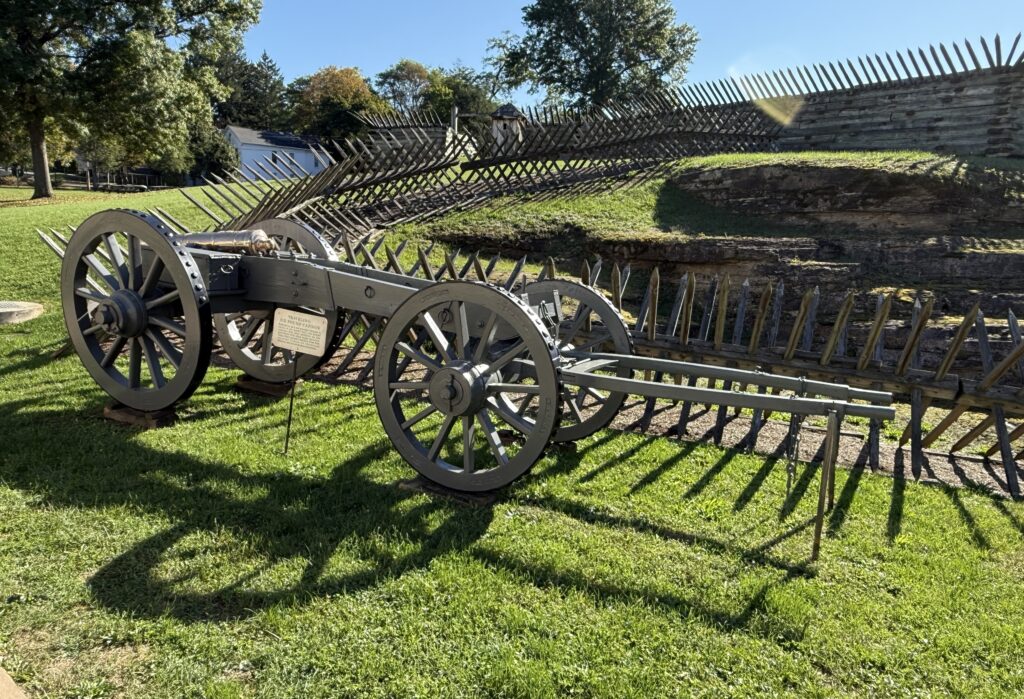
We didn’t go to Fort Necessity to see an early frontier fort; we went because this meadow is where global history pivoted. On July 3, 1754, a 22-year-old Lt. Col. George Washington fought and lost- his first significant engagement here. That defeat, following his skirmish at Jumonville Glen, helped ignite the French and Indian War in North America, which widened into the Seven Years’ War, the first truly global conflict. The National Park Service frames it plainly: this was the opening action of that war; Mount Vernon’s historical encyclopedia echoes that view and ties it to Washington’s earliest command experience. Standing inside the small circular stockade, it’s sobering to realize that decisions made on this meadow rippled outward to redraw empires, reshape North America, and set conditions for the American Revolution.
The National Park Service museum at Fort Necessity offers a thoughtful and well-curated introduction to the site’s history. Through clear exhibits and engaging interpretation, it provides important context for the events that unfolded here and the people involved. We were especially impressed by how accessible and informative the museum is, making the story easy to understand while still honoring its significance.
Jumonville Glen


Located in the woods of Pennsylvania’s Laurel Highlands, Jumonville Glen is a quiet, contemplative place with an outsized role in world history. The site is part of the National Park Service. The shaded ravine marks the site of the 1754 skirmish involving a young George Washington and French forces led by Joseph Coulon de Jumonville, an encounter that helped ignite the French and Indian War. That conflict would eventually draw in major European powers and is often cited by historians as the first truly global war, laying the groundwork for what many consider the earliest form of a world war.
Today, the short hike to the glen is peaceful and unassuming. The trail is easy to navigate, yet as you step into the narrow hollow, it’s not hard to imagine how the landscape itself shaped the events that unfolded here. Surrounded by stone and forest, the site invites reflection on how a moment in a quiet Pennsylvania ravine rippled outward, changing the course of global history.
Fort Ligonier (Washington’s 1758 chapter)


We were very impressed by the privately owned museum at Fort Ligonier; its exhibits are magnificent, deeply informative, and beautifully presented, offering layers of context that enriched our visit. After exploring the museum, you can wander through the faithful recreation of the fort, which truly transports you back in time. The staff are knowledgeable and welcoming, and the museum’s location within walking distance of historic downtown Ligonier added even more charm to our day.
Four years after the events at Fort Necessity, Washington returned to these mountains as colonel of the Virginia Regiment during General John Forbes’s 1758 campaign to capture Fort Duquesne (present-day Pittsburgh). Fort Ligonier, an eight-acre forward base on the Forbes Road, served as the British staging point where Washington drilled troops, wrote reports, and, on a chaotic November evening, found himself amid a tragic friendly-fire incident when two detachments mistook each other for the enemy. Contemporary accounts describe him riding between the lines, using his sword to knock aside muskets to halt the firing. Recent archaeological work has pinpointed the likely site of the incident and unearthed artifacts now on display at the fort. The greater arc of the campaign succeeded: the French abandoned Fort Duquesne, the British occupied and renamed it Pittsburgh, reshaping control of the Ohio Valley and Washington’s own understanding of command.
Road Culture: Lincoln Highway Experience
Why the Lincoln Highway is a Huge Deal


Before numbered U.S. highways or the modern Interstate System, cross-country driving was more dream than reality, a patchwork of dusty, disconnected routes stitched together by visionaries. Among the earliest and boldest of these, the Lincoln Highway stands out as the road that changed everything. Conceived by entrepreneur Carl G. Fisher and dedicated in 1913, it became the nation’s first coast-to-coast automobile route, proudly nicknamed “The Main Street Across America.” Stretching from Times Square in New York City to San Francisco, it transformed how Americans saw their country and how small towns like those in the Laurel Highlands connected to the broader world.
Moreover, the Lincoln Highway was far more than a novelty for early motorists. It ignited the Good Roads Movement, championed improved road infrastructure, and inspired an entire culture of roadside architecture, from gas pumps and motor courts to diners glowing under neon signs. In fact, the Federal Highway Administration later described the Lincoln Highway Association as the era’s most influential trail group, noting how its innovative marketing and civic partnerships laid the foundation for the national highway system we know today.
Lincoln Highway Experience Museum


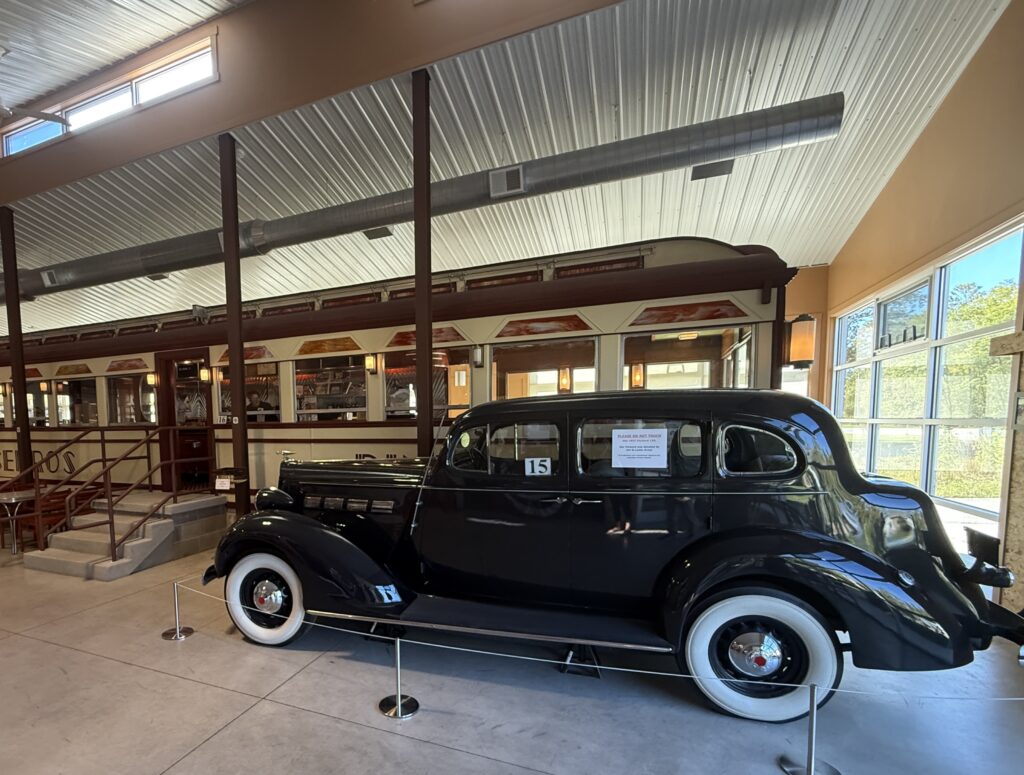
Later in our journey, when we toured the Lincoln Highway Experience Museum in Latrobe, Pennsylvania, that history came vividly to life. Inside its recreated 1930s diner, complete with checkered floors, vintage signage, and slices of pie served with steaming coffee, we could almost imagine those first adventurers stopping to rest after miles of gravel and mud. As we explored further, interactive exhibits, antique cars, and roadside memorabilia revealed how this 1913 idea reshaped travel itself.
Ultimately, standing there among the exhibits, we realized something simple but powerful: the scenic byways we were driving across the Laurel Highlands are the living descendants of the Lincoln Highway. In many ways, every modern road trip owes a quiet debt to that audacious dream of connecting people, places, and possibilities, one mile at a time.
Make sure to leave yourself time to enjoy a fresh slice of pie and a cup of coffee in the beautifully restored diner car.
Architecture in Harmony with Nature: Frank Lloyd Wright Country
The Laurel Highlands are home to one of the world’s richest concentrations of Frank Lloyd Wright architecture. Three major sites—Fallingwater, Kentuck Knob, and Polymath Park sit within an hour’s drive of each other, each showing a different stage of Wright’s evolution. Experiencing them together revealed just how deeply these Appalachian landscapes inspired his work.
Fallingwater


If any single site defines Wright’s vision of “organic architecture,” it’s Fallingwater. Built in 1935 for Pittsburgh department-store owners Edgar and Liliane Kaufmann, the house doesn’t look at the waterfall; it is the waterfall. Wright anchored its sandstone walls to the rock ledge and launched concrete cantilevers over Bear Run, so the sound of the water is constant.
Inside, low ceilings compress space before releasing it outward to forest views. Corner windows open with no mullions to interrupt the landscape. Built-in furniture mirrors the terraces’ geometry, and the palette of ochre, concrete, and native stone blends seamlessly with moss and tree bark.
The Western Pennsylvania Conservancy offers tours ranging from in-depth architectural explorations to ground-only hiking passes. A gallery, café, and shop extend the experience, displaying Wright’s drawings and preservation work. We left convinced that great design isn’t only something you see, it’s something you feel.
Kentuck Knob


Only seven miles from Fallingwater, Kentuck Knob translates Wright’s philosophy into a livable form. Commissioned by ice-cream entrepreneurs I.N. and Bernadine Hagan in 1953, the home nestles high on a wooded ridge overlooking the Youghiogheny River Gorge. Its hexagonal floor plan eliminates hallways, encouraging a smooth flow and ample light.
Walls of native sandstone rise beneath a sweeping copper roof; clerestory windows run unbroken beneath the eaves, scattering shifting light across red cypress walls and flagstone floors. Every detail, from door handles to built-ins, shows Wright’s insistence on unity.
Outside, a sculpture meadow added by later owners, Lord and Lady Palumbo, features works by modern artists such as Anthony Caro and Andy Goldsworthy. We wandered through it after the house tour, surrounded by art, wind, and the quiet hum of crickets, a scene Wright himself would have loved.
Polymath Park


Finally, our architectural journey led us to Polymath Park, near Acme, Pennsylvania, a serene woodland estate that carries Frank Lloyd Wright’s legacy into the present day. Nestled among towering pines and quiet ridgelines, this site unites two Wright-designed houses, Duncan House (1957, relocated from Illinois) and Mäntylä (1952, relocated from Minnesota), alongside two homes by his apprentice Peter Berndtson, the Balter and Blum Houses. Here, visitors can explore by day or, for an even deeper connection, stay overnight in these architectural landmarks, sleeping inside the philosophy of organic design itself.
To fully experience it, we joined the popular “Lunch Tour” at TreeTops Restaurant, a glass-and-timber pavilion that seems to float among the trees. As we dined on locally sourced dishes, our guide shared stories of Wright’s later “hemicycle” designs, his elegant circular floor plans that embraced the natural curves of the landscape. After lunch, we stepped onto the terrace of the Duncan House, where the golden light filtered through the forest canopy. In that moment, surrounded by quiet and geometry, we understood why Wright returned to nature again and again: this landscape humbles and inspires in equal measure.
Taken together, Fallingwater, Kentuck Knob, and Polymath Park create a narrative arc of revelation, refinement, and legacy. Experiencing them back-to-back, each building whispering to the next, transformed our trip into an immersive masterclass in American design and a testament to how art, architecture, and nature can coexist in perfect harmony.
Nature Days: Waterfalls, Overlooks & Underground Wonders
The Laurel Highlands are where Pennsylvania’s wild heart beats loudest. Even after all the history and architecture, it was the region’s raw, untamed side that took our breath away. Here, nature doesn’t sit quietly in the background; it rushes, soars, and glows around every bend.
Ohiopyle State Park


If one place defines the outdoor spirit of the Laurel Highlands, it’s Ohiopyle State Park.
The park spans over 20,000 acres along the Youghiogheny River Gorge. Forests, waterfalls, and rocky outcrops create a playground for hikers, bikers, and paddlers. As soon as we arrived, the river’s rhythmic roar filled the air. It was a steady, powerful sound that drew everyone closer.
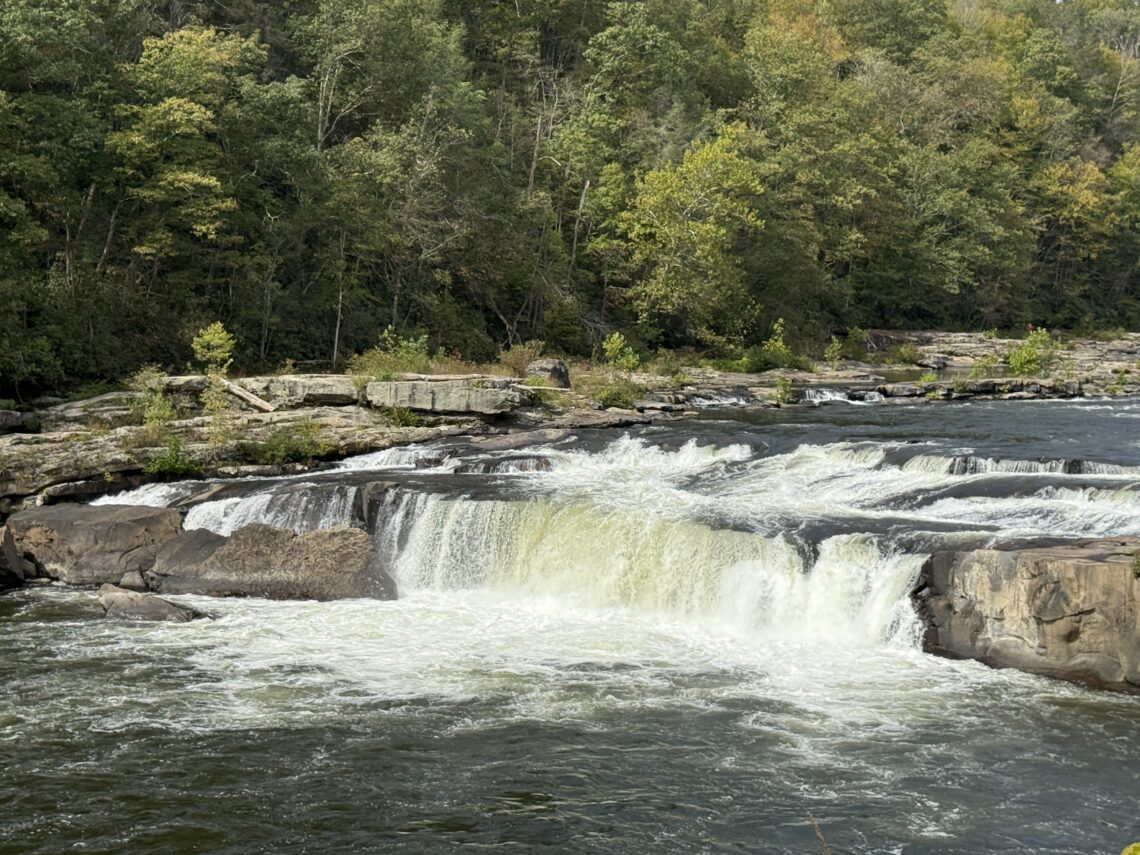
We began our visit at Ohiopyle Falls, where the Youghiogheny crashes over a 20-foot sandstone ledge. The falls sit right in the heart of town, surrounded by a riverside boardwalk. Viewing platforms make it easy to pause and take it all in. Locals told us the falls transform with each season. They thunder in spring, shimmer in summer, and freeze into artful sculptures in winter.
Afterward, we drove uphill to Baughman Rock Overlook, one of the Highlands’ most breathtaking views. From this high perch, the forest seemed endless in every direction.
Emerald valleys stretched below, fading into a soft blue mist. In that quiet moment, time seemed to pause completely. Words felt unnecessary; the view said everything.
Ultimately, Ohiopyle State Park restores you even in a brief visit. The air smells of pine and moss, and sunlight filters through the trees like honey. Every sound the wind, the water, the birds remind you that the landscape is alive.
Laurel Caverns


From roaring water to silence, our next stop completely changed the tempo. It felt as if the world had flipped upside down. Deep beneath Chestnut Ridge, Laurel Caverns extends for more than four miles. It is Pennsylvania’s most extensive cave system. As we descended, daylight faded, giving way to a soft, echoing darkness. Entering its vast chambers felt like stepping into another world. Time slowed, and sound carried like whispers through the stone.
Our guide led us through large rock chambers shaped by ancient underground streams. We moved through narrow passages as flashlight beams traced mineral-streaked walls. The air grew cooler with each step, and the quiet underground made the experience feel focused and immersive. Beyond sightseeing, Laurel Caverns also works as a hands-on learning space, offering geology tours, guided spelunking, and programs for young explorers. It’s one of the more distinctive experiences in the Laurel Highlands.
When we emerged back into daylight, the forest felt noticeably brighter. The air was crisp, with the scent of pine all around us. The experience stayed with us—not for thrills, but for the simple sense of wonder and connection to the landscape.
The Ever-Changing Highlands


What struck us most about the Laurel Highlands is how alive the landscape likely feels year-round. In spring, wildflowers carpet the forest floor. In summer, rivers sparkle and the air hums with the buzz of trails. Fall turns the mountains into fire reds, golds, and oranges that make even a short drive feel cinematic. And in winter, the waterfalls freeze mid-cascade, becoming crystal sculptures beneath snow-dusted pines. We came as the Fall colors were emerging; we would have loved to have seen them at their peak.
Nature here isn’t something you check off an itinerary; it’s something you enter into. Whether standing at an overlook, hiking a trail, or just pulling over to watch the sunset spill across a ridge, the Laurel Highlands remind you that beauty is often found in stillness.
Covered Bridges: Timeless Crossings
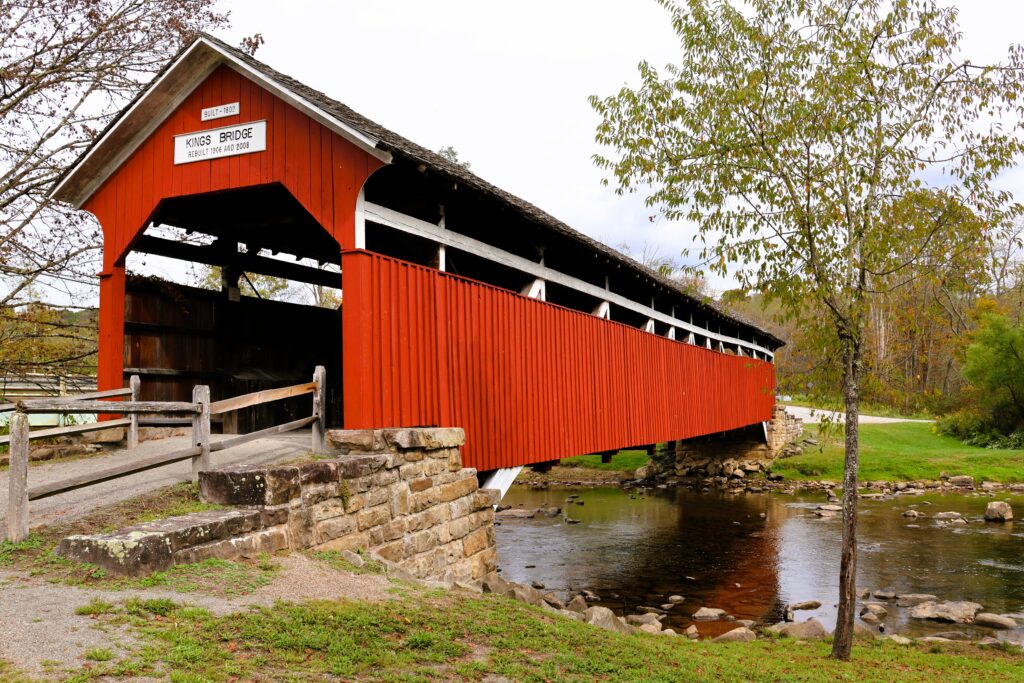
The Laurel Highlands are dotted with historic covered bridges, each one a quiet reminder of 19th-century craftsmanship and rural ingenuity. These wooden spans once sheltered horse-drawn carriages from rain and snow. Today, they add a storybook charm to the countryside. We’ve always had a soft spot for them, so when our itinerary allowed, we made sure to visit at least one. Kings Bridge in the picture just happened along our path, and of course, we had to stop.
Standing inside its shadowed beams, sunlight filtering through the weathered slats, we felt that familiar sense of calm and nostalgia. In a region renowned for its grand architecture and dramatic landscapes, these simple bridges hold a beauty of their own: steadfast, enduring, and quintessentially Pennsylvania.
Towns We Explored in the Laurel Highlands (and Why They Work as Bases)
Connellsville


Connellsville became our anchor for exploring the Laurel Highlands, a river town with a rich past and a vibrant present. Once a center of coal mining and coke production, it fueled America’s industrial growth, and remnants of that history still linger in the town’s streets and stories. Today, revitalization efforts have breathed new life into Connellsville, making it a welcoming destination for outdoor travelers. It is a popular overnight stop with cyclists riding the Great Allegheny Passage.
We felt that mix of history and modern charm at the Connellsville Canteen, where café breakfasts sit alongside WWII exhibits and a miniature railway display. Connellsville seamlessly combines its industrious past with a renewed energy, making it a memorable stop in the Laurel Highlands.
Ligonier


After touring Fort Ligonier, we lingered because Ligonier begs you to slow down. The Diamond, a grassy square framed by boutiques, feels like a living postcard. Before and after lunch at The Kitchen on Main (so yummy), we wandered Main Street, stopping in antique stores, art galleries, and artisan shops. We also purchased a few items to take home.
We heard a bit about Fort Ligonier Days during our visit. It is an annual fall festival that celebrates the area’s rich colonial heritage and small-town charm. Centered around the reconstructed Fort Ligonier, the event features Revolutionary-era reenactments, craft demonstrations, live music, and period costumes that bring the 18th century to life. Visitors can explore rows of artisan vendors, enjoy classic festival foods, and watch parades and historical programs throughout the weekend. Drawing thousands of attendees each year, Fort Ligonier Days blends history, community spirit, and seasonal celebration, making it one of western Pennsylvania’s most beloved autumn traditions.
Latrobe


In Latrobe, home of the banana split and Fred Rogers, we snapped a photo with Mister Rogers’ statue. Who doesn’t love Mr. Rogers? We also visited the banana split monument, as it was created in Latrobe. After exploring downtown, we settled in at Unity Brewing and Four Seasons Brewing Company for craft beer and flatbreads. Friendly, easygoing, and unpretentious, these are the things people love about Pennsylvania towns.
Heritage & Industry: West Overton Village & Museum


We ended our journey at West Overton Village & Museum in Scottdale, a 40-acre preserved 19th-century farm complex founded by the Overholt family. It’s the birthplace of industrialist Henry Clay Frick and the original home of Old Overholt Rye Whiskey. Today, the museum’s Whiskey Heritage Center and Sam Komlenic Gallery display more than 270 historic Pennsylvania whiskey bottles and over 450 related artifacts, from barrels to vintage labels. This was an excellent museum on every level!
Interpretive exhibits fill the former 1859 distillery and gristmill, linking farm, industry, and craftsmanship. West Overton also hosts tastings and seasonal events, carrying that heritage forward. Standing beneath the brick arches, we could feel the continuity between past and present, a fitting finale to a journey built on connection. Of course, we had to conduct some whisky tasting, one of the rough parts of this job. We were impressed and bought a couple to bring home.
Adventure Awaits: Trails and Rapids in the Laurel Highlands


While our focus was history and culture, it’s hard to miss the Laurel Highlands’ outdoor appeal. This region is a haven for adventure seekers. The Great Allegheny Passage, a 150-mile rail trail from Pittsburgh to Cumberland, Maryland, runs straight through the area. It passes through towns such as Ohiopyle and Connellsville. The trail is mostly flat, making it ideal for cycling or long walks. Along the way, cafés, outfitters, and riverside parks are easy to access.
The Youghiogheny River is equally well known for white-water rafting. The Lower Yough near Ohiopyle is one of the best Class III–IV runs on the East Coast. The Middle Yough offers a gentler option for families and first-time rafters. Outfitters in Ohiopyle provide guided trips, rentals, and popular “pedal and paddle” experiences. We met cyclists riding the Passage, and their excitement about the journey was contagious.
Winter Wonders in the Highlands

The adventure doesn’t end when the snow falls. In many ways, winter makes it better.
During winter, the Laurel Highlands becomes one of Pennsylvania’s top cold-weather destinations.
Skiers and snowboarders head to Seven Springs, Hidden Valley, and Laurel Mountain. Together, these resorts offer trails, terrain parks, and tubing for all skill levels. For a quieter pace, cross-country skiing and snowshoeing wind through Ohiopyle State Park and Laurel Ridge State Park. Snow-covered forests and frozen streams create a calm, scenic backdrop.
Beyond the slopes, icy waterfalls, and snow-dusted overlooks make winter hiking especially memorable. At day’s end, cozy lodges, crackling fireplaces, and relaxed après-ski dining add warmth and comfort. Winter in the Laurel Highlands feels both peaceful and cinematic.
Where We Stayed: The Château Connellsville


One of the most memorable aspects of our trip, and the heartbeat of our stay, was The Château Connellsville, a place we will never forget.
Housed in a stately early-20th-century building that once served as a convent, this boutique property at 114 N Prospect Street has been lovingly transformed into a ten-suite themed retreat. Each room channels a different era: Art Deco, Victorian, Mid-Century Modern, and Renaissance. It pairs character with comfort, featuring rainfall showers, mini-fridges, coffee bars, smart TVs, and thoughtful touches like plush robes and original art.
For travel writers on assignment, practical details count: fast Wi-Fi for uploads, ample parking, complimentary breakfast, and secure bike storage for GAP trail riders. Yet what set the Château apart was its soul. The historic woodwork and arched hallways hint at its past life, while the owners’ hospitality makes you feel instantly at home.
Our Mid-Century Modern Suite features two bedrooms and is serene, with clean lines, warm wood, and a rainfall shower that soothes road-weary muscles. Evenings ended on the patio, reviewing photos over espresso as the town settled quietly around us. The Château did more than host us; it became part of our story, a symbol of how the Laurel Highlands repurpose history into something beautifully new.
Booking Accommodations in the Laurel Highlands
Although we loved the Château, there are many other accommodations in this expansive region. Large resorts to home rentals, you can click the links below to see what might suit your travel needs.
When planning a trip, it’s always wise to compare accommodation prices across different platforms. Expedia, based in the U.S., and Booking.com, based in Europe, don’t always feature the same properties, so checking both can give you the best range of options. We prefer Booking.com for its user-friendly interface and wide selection, but we always recommend double-checking the hotel or vacation rental’s official website. Sometimes, you’ll find exclusive deals or perks when booking directly.
Click the link below to explore hotels and vacation homes in the area you are planning to visit. Who knows? It might be just the spark you need to start planning your next grand adventure.
Where We Dined & Refueled
- Tailgatez Sports Grill (Somerset) — Classic comfort food and quick service after the memorial.
- Silver Horse Coffee (Donegal) — Local roaster, fresh pastries, and garage-door seating with mountain views.
- Falls Market Restaurant (Ohiopyle) — Wraps and sandwiches ideal for picnics by the river.
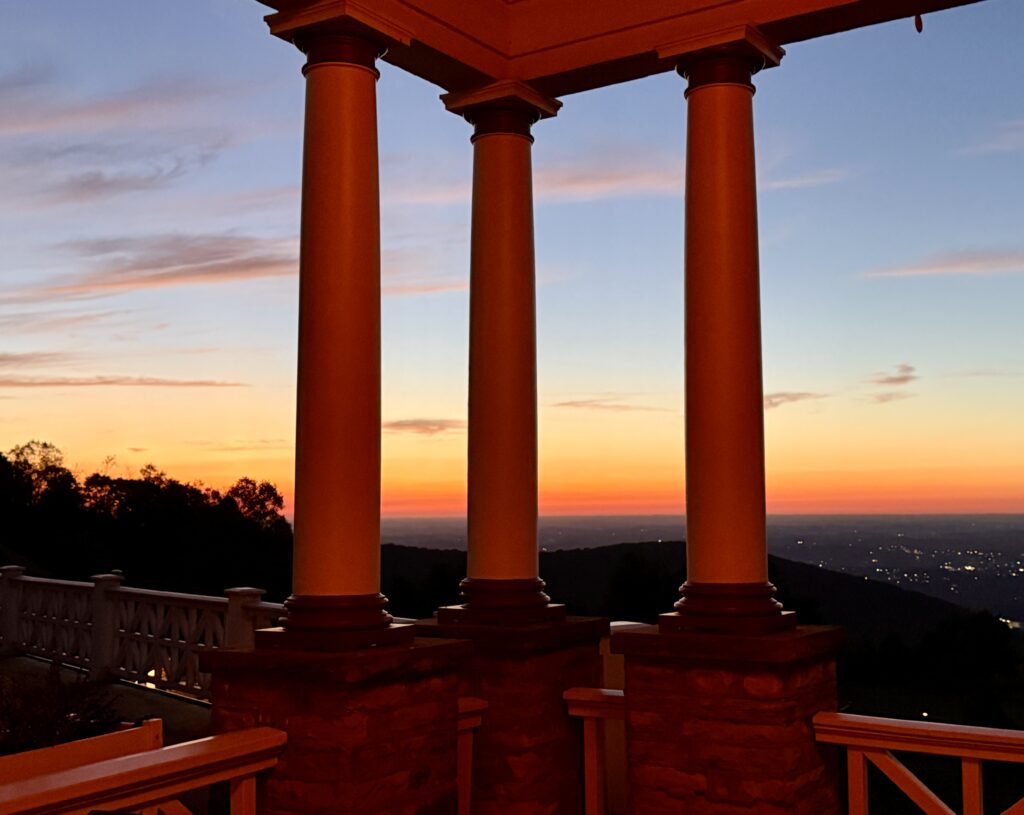
- Historic Summit Inn (Farmington) — Dinner on its veranda with sunset over the mountains.
- Olde World Coffee & Gelato (Connellsville) — Espresso and gelato for breakfast because travel is meant to be fun.
- Yough River Brewing (Connellsville) — Friendly local brewpub with seasonal taps.
- Unity Brewing (Latrobe) — Inventive pub menu and rotating craft flights.
- The River’s Edge (Connellsville) — Riverside patio dining and live-music nights.
Practical Notes for Future Travelers
Book Frank Lloyd Wright tours early. Peak autumn dates fill fast.
- Pair Ohiopyle and Laurel Caverns in one day to experience the contrast between light and dark.
- Use a base town. Connellsville reduces drive time and adds local flavor.
- Check hours seasonally. Fort Necessity, Lincoln Highway Experience, and West Overton adjust with the calendar.
- Talk to locals. Their tips led us to Silver Horse Coffee and the perfect picnic spot in Ohiopyle.
Why the Highlands Will Stay With Us
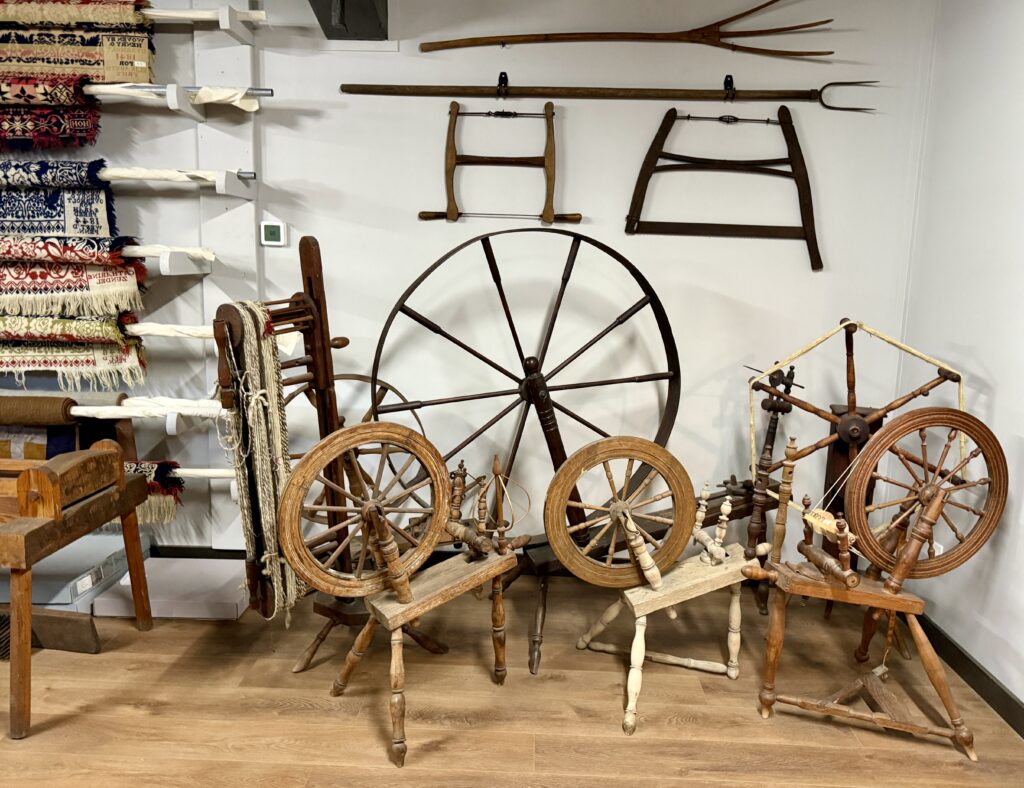
By the time we turned the car homeward, the Laurel Highlands had worked their quiet magic. In four days, we experienced remembrance at Flight 93, frontier stories at Fort Ligonier and Necessity, and architectural design that made us pause in awe. We walked waterfalls, breathed cave air, browsed boutiques, and ended each day in a hotel that felt like a story.
The Laurel Highlands don’t shout for attention; they whisper it. Begin with reflection, wander through history, linger over architecture that listens to the land, and end with hospitality that warms the heart. That’s what we found here. That’s what will draw us back.
© 2026 Wanderers Compass All Rights Reserved
We encourage you to visit the Go Laurel Highlands Tourism website, which provides a wealth of information to help you plan your visit. The visitor center is located in Historic Downtown Ligonier.
*The Go Laurel Highlands visitors bureau graciously hosted us during our visit. We sincerely thank them for the opportunity to experience the region and its many historic and cultural highlights. All opinions shared are our own and based on our personal experiences.*
Check out our most recent posts




Want to learn the story behind Wanderers Compass?
Our Top Recommended Travel Products
Travel Insurance
Squaremouth.com
Our Favorite Travel Insurance Site!
We strongly advocate comprehensive travel insurance, not only for minor inconveniences but also for major, unexpected events such as medical emergencies. We never leave home without it. Our go-to resource is Squaremouth.com. which offers a user-friendly platform that connects you with top-rated, reputable insurance carriers. Plus, they’ll mediate on your behalf if you run into any issues.
To empower you as a consumer, we recommend you read our blog post on why travel insurance is essential and how to secure the best coverage from leading companies at an affordable price.
MedjetAssist
Medical transport back home from anywhere in the world
Medjet is a leading provider of global air medical transport. Unlike traditional travel insurance, which typically covers medical evacuation to the nearest facility, Medjet goes further by ensuring you’re transported back to the U.S. to the hospital of your choice once you’re stable enough to fly. Medjet offers membership plans that focus on medical transport, while Medjet Horizon provides expanded coverage for broader protection. Individual trip policies start at just $99, and annual policies are available for around $300. Most policies have an age limit of 74.
To learn more about how Medical Evacuation membership with Medjet Assist works, check out our blog post for a more detailed review.
Accommodations and Airfare
Booking.com
Hotels, Home rentals, BNBs, Flights, and other Transportation & Tours
Booking.com connects millions of travelers to unforgettable experiences, a wide range of transportation options, and incredible places to stay—from homes to hotels and beyond. As one of the world’s largest travel marketplaces, it supports well-known brands and entrepreneurs of all sizes. For its convenience, variety, and reliability, it’s our preferred booking platform.
Expedia and VRBO
Hotels, home rentals, BNBs, flights, and other transportation & tours
Expedia is a U.S.-based company with a mission to make global travel accessible to everyone, everywhere. At Wanderers Compass, we embrace independent travel, and platforms like Expedia are essential to making that a reality. Expedia allows you to book every aspect of your trip—from flights and accommodations to rental cars, cruises, and activities—making it a one-stop shop for all your travel needs.
Transportation
Daytrip
Personalized city-to-city private car transfer service
Daytrip provides an affordable private car service for city-to-city transfers worldwide, and we absolutely love their service. It’s a cost-effective alternative to renting a car, offering comfortable, stress-free travel with the added benefit of scenic stops along the way. For example, we used Daytrip for travel between Budapest and Vienna, enjoying some fantastic detours to local attractions. With professional drivers and customizable routes, Daytrip ensures a smooth ride while allowing you to explore hidden gems and unique sights along your journey.
To learn more about Daytrip, check out our blog post for a more detailed review.
Travel Experiences
Viator
The leading marketplace for travel experiences
Viator believes that travel is all about creating unforgettable memories. With over 300,000 experiences to choose from—ranging from simple tours to extreme adventures, plus a wide array of unique, niche activities—it’s never been easier to make lasting memories. We frequently use Viator during our travels and especially appreciate its flexible cancellation policy, which provides peace of mind with every booking.
Communication products for seamless connectivity overseas
GigSky International eSIM Data Plans
Local Prices. No Roaming. Fastest Networks.
GigSky eSIM effortlessly connects travelers worldwide, eliminating the need to swap physical SIM cards or face unexpected roaming charges. With affordable data plans and instant activation, you can enjoy reliable internet access in over 190 countries, making your travel experience more convenient than ever. Plus, they offer a fantastic deal: a free 100 MB data plan with no credit card required. They are so confident that you will love their service!
Enjoy 10% off all GigSky Plans (except cruise and inflight) with our discount code WCOMPASS10.
To learn more about how GigSky works, check out our blog post for a more detailed review.
Shopping
Wanderers Compass Amazon Storefront
An excellent source for all travel essentials and guides that we have vetted ourselves
Amazon is one of the world’s most comprehensive online shopping platforms, offering lower prices, a wide selection, and fast delivery through its global fulfillment network.
This page contains affiliate links. When you purchase through these links, we may earn a small commission at no extra cost to you. Thank you for your ongoing support!


